What happens between cancer treatments is invisible — until it isn't.
Capturing patient experiences in real time to improve care, communication, and outcomes.
Meet Maria
Maria is 47, halfway through chemotherapy. Between treatments, fatigue and nausea come in waves she's not sure how to describe — or whether they're worth mentioning.
By her next appointment, the details have blurred. "I'm doing okay," she says — because it's easier than explaining everything she's forgotten.
Maria's story is not unique — it reflects a broader breakdown in how patient experiences are captured and used in cancer care.
Where the system fails
The breakdown isn't any one person's fault — it's structural, happening across three sides of care at once.
Hard to remember, harder to describe
- Memory fades between appointments
- Symptoms are hard to put into words
- Unsure what's worth reporting
Too little time, too much to track
- 15-minute visits to cover weeks
- Reliant on patient recall in the moment
- Hard to spot trends between visits
Data that doesn't connect
- Experiences captured unstructured
- Reporting delayed until next visit
- Lived experience rarely informs care
What research shows
Real-time symptom monitoring improves survival.
Basch et al., 2017
Patients underreport symptoms when relying on memory.
Pakhomov et al., 2008
Trends over time predict complications better than single reports.
Denis et al., 2019
Symptom monitoring doesn't fail for lack of data. It fails because data is captured at the wrong time, in the wrong format, and without context.
Designing around the gap, not around it.
If the breakdown happens because data is captured at the wrong time, in the wrong format, and without context — then the answer isn't more reporting. It's reporting that fits into a patient's day and lands in a clinician's hands ready to use.
Our Path responds to each part of that gap directly: capture in the moment, structure that preserves meaning, and summaries that travel with the patient into the next visit.
Turn patient experiences into clear, actionable insights.
Log Symptoms Easily
Patients record how they feel between visits using simple prompts, quick selections, or voice input.
Automatically Organized
The system translates patient input into structured summaries, highlighting severity, timing, and key changes.
Ready for Your Visit
Patients and clinicians receive prioritized insights and trends to guide more effective conversations.
Built around what patients and clinicians actually need.
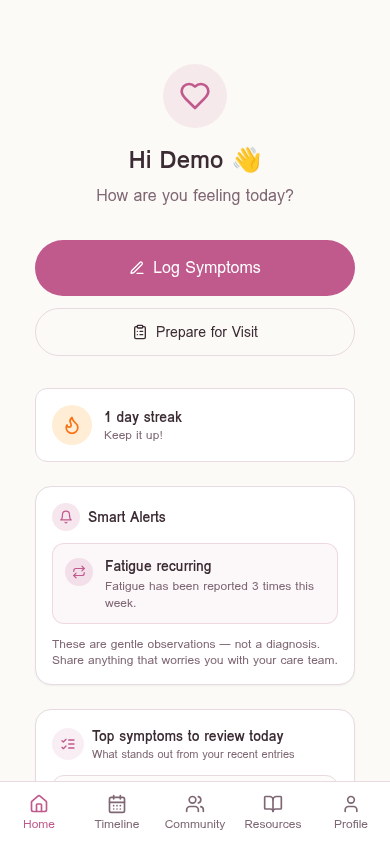
See What Matters Most
Automatically highlights the most important symptoms to review.
Never Miss Changes
Detects new, worsening, or recurring symptoms over time.
Understand Trends
Visualizes how symptoms evolve across days and treatment cycles.
Speak Your Experience
Captures patient voice through prompts, text, or voice input.
Translate to Clinical Insight
Converts patient language into structured, standardized summaries.
Prepare for Better Visits
Generates visit-ready summaries so nothing important is missed.
Explore the project
Problem
Why people feel lost when symptoms appear.
OpenSolution & Product
Meet Our Path and what it does.
OpenProcess Innovation & Business Plan
Our design journey and how it could grow.
OpenTeam & Roles
Who built it and what each of us did.
OpenReferences
Sources and inspiration that shaped our work.
OpenBuilt by a small, curious team.
Designers and researchers who wanted health tech to feel less clinical and more human. Meet the people behind Our Path.